Bird-Brained: Insult or Compliment?

Articles

By Kari Zelinskas
[from spring 2026 newsletter]

Derogatory expressions such as bird-brain, crazy as a loon, and dumb as a dodo imply birds lack intelligence or common sense. But modern research has debunked that idea, finding bird brains are quite complex and neuron dense, displaying similar neuronal organization and connectivity to mammals. In fact, birds have larger brains relative to their body size than all other vertebrates except mammals.

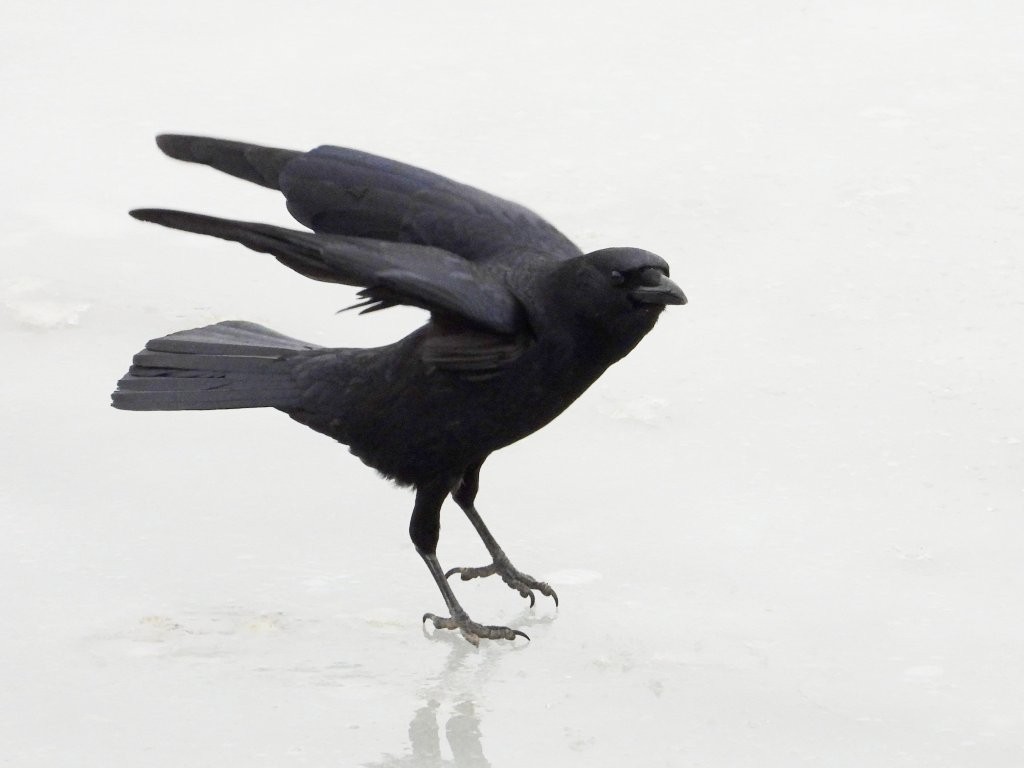
Learning how to learn is a measure of intelligence. Some birds, notably corvids such as Crows, Ravens, and Blue Jays, have demonstrated the ability to solve problems and use tools. For example, scientists have observed Crows in the wild using sticks with their beaks to extract insects from logs, and in labs, Crows have solved puzzles to get to food. They have also observed Carrion Crows and American Crows cracking hard-shelled nuts by dropping them on crosswalks, letting cars run over them.

Birds must learn the complex activity of song. Songs of the same species vary from region to region depending on what young birds learned from their parents. Young males in a new territory will often sing the “dialect” applicable to that territory.

The hippocampus region controls bird memory. In birds that engage in caching (hiding seeds or nuts in locations and later retrieving them), the hippocampus is larger than birds who do not cache. The hippocampus in the Black-capped Chickadee, for example, grows during cache season, heightening its ability to remember its cache locations.

And how do birds compare to our beloved domesticated pets? Crows and Parrots often perform as well as dogs in tests that involve reasoning or learning. Blue Jays are able to master food-locating tasks that cats cannot. House Sparrows have learned to open automatic doors to grocery stores and cafes by hovering in front of the electric eye sensors. Can Fido or Fluffy do that? Maybe. But then, can Fido or Fluffy find their way to South America and back? Maybe not.
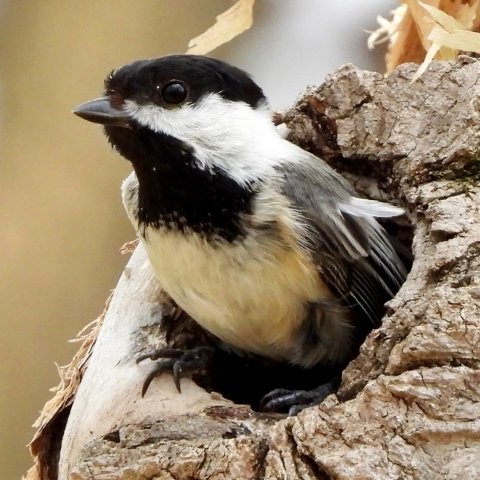
Black-capped Chickadee
© Mary Leigh

Related Posts

Articles

By Kari Zelinskas
[from winter 2025 newsletter]

Meet the elusive Eastern Screech-Owl. Nocturnal, they roost during the day and hunt at dusk and night. Despite the name, Screech-Owls don’t just screech...

Articles

By Kari Zelinskas
[from winter 2025 newsletter]

Did you know there are different names for the flocks of birds? You might see a blush of Robins, a charm of Finches, or a confusion of Warblers.

Articles

By Kevin Koch
[from fall 2025 newsletter]

The next time you’re tempted to feed the birds from that bag of bread, think again! You might just be depriving your feathered friends of a broader range of nutrition they’ll need throughout the year.

While bread does contain carbohydrates, bird specialist Dr. David Shealer, Professor of Biology at Loras College in Dubuque, IA, points out that birds also need proteins and fats in their diet...

Articles

By Mary Leigh
[from fall 2025 newsletter]

This summer, I went on a guided bird walk at Cornell Lab of Ornithology's Sapsucker Woods, in Ithaca, NY... During the walk, our guide shared some fun facts about American Goldfinch that make them unusual.

Articles

[from summer 2025 newsletter]

Question: Is it OK to feed bread to birds?
Answer: No! Please help us spread the word that birds should not be fed bread, popcorn, crackers, chips, cereal, and most processed foods.

Articles

By Tony Moline
[from spring 2025 newsletter]

Question: Why do birds flock to gravel roads in the wintertime? Answer: Because they have no teeth! Instead, birds have a gizzard, a muscular part of their stomach that helps them grind up food. Small rocks and sand (or grit) are ingested by birds to create “teeth” in the gizzard.

Articles, Local Sightings

By Marty Corfman
Dubuque Audubon Society President

I will never stop being awed by this phenomenon, called a murmuration, when birds fly in synchronized patterns. This time of year, these formations can be seen most often toward dusk, when birds are looking for a roosting site, but they can be seen throughout the day as well.

Articles

By Mary Leigh
[from winter 2024 newsletter]

Question: Do American Robins remain in the Midwest all winter?
Answer: Yes! Although American Robins are regarded as a sign of spring in the Midwest, they are here year-round.

Articles

By Mary Leigh
[from winter 2024 newsletter]

I noticed recently that my eBird life list bird count increased by 1 when I hadn’t added any new species. The explanation was the annual taxonomy update! Every year, based on new insights by ornithologists, species are split, lumped, and renamed.

Articles, Local Sightings

By Marty Corfman
[from fall 2024 newsletter]

My husband and I were driving past Wartburg Theological Seminary in Dubuque at dusk, and I heard and saw many swifts hunting insects in the sky. I said, “Pull over, honey! This is gonna be cool!”

Articles

By Bob Walton
[from fall 2024 newsletter]

All sports have rules to follow, and birding should be no different. It is important that the welfare of all our birds be respected, resulting in little or no disturbance to the birds. The American Birding Association (ABA) has developed a Code of Birding Ethics that promotes respectful, enjoyable, and thoughtful birding.

Articles

[from March 2024 newsletter]

Doug Harr, president of the Iowa Audubon Society, recently received copies of some pages from Bird Lore magazine (an early publication started in 1899 by the original Audubon Society). The pages dated from 1899 to 1917. He shared these historical notes: