By Bob Walton
[from summer 2026 newsletter]
March 7th found Sandy and me at the Green Island Channel 4 parking lot around 5:20 a.m. to participate in the Dubuque Audubon’s 47th annual spring waterfowl watch. I have always enjoyed the pre-dawn sounds of the marsh and try to be there as much as an hour before the main group arrives at sunrise. This time is probably best described by Aldo Leopold in his Sand County Almanac when he said, “To arrive early in the marsh is an adventure in pure listening…and when a flock of bluebills, pitching pondward, tears the dark side of heaven in one long circling nosedive, you catch your breath at the sound, but there is nothing to see except stars.”
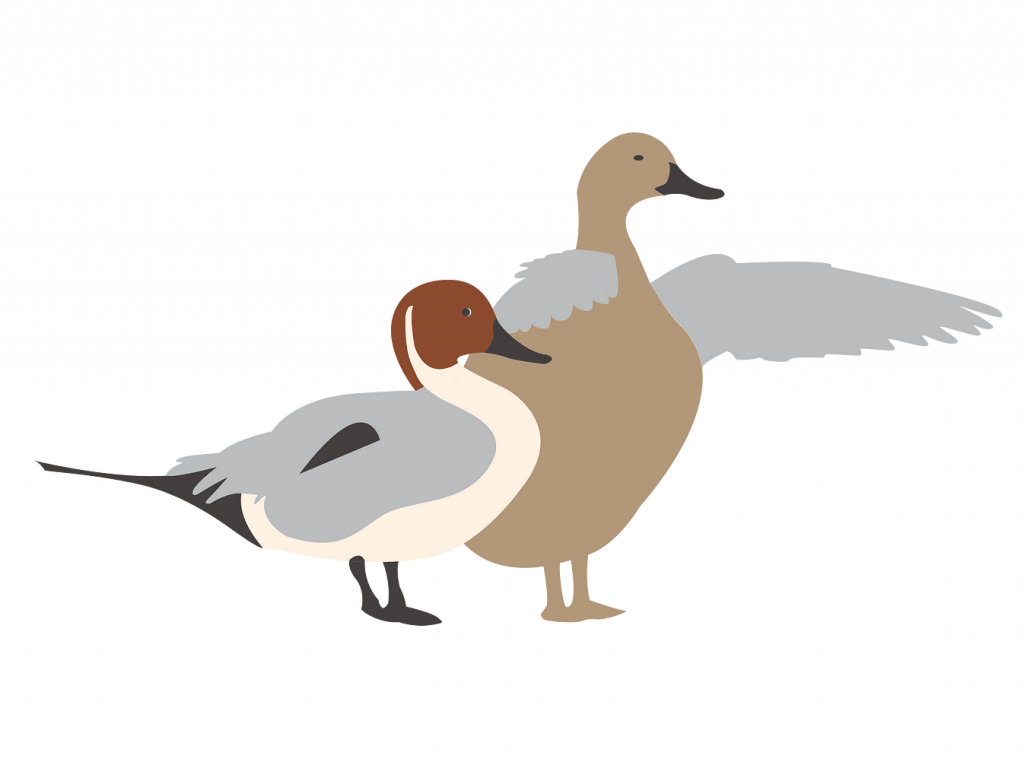
It was totally dark when we pulled into the Channel 4 parking lot and lowered our windows, to be immediately greeted by the raucous call of a resident Canada Goose warning that we were near his nesting territory. His honking was soon followed by more honking and the unmistakable quack of migratory female Mallards as a flock of hundreds took to the air. As the eastern horizon began to glow, the area over the Mississippi had large smoke-like clouds of ducks and White-fronted Geese. As if on cue, a small flock of bluebills (Lesser Scaup) pitched downward with a roar from their wings and landed somewhere in the wetlands to the south of the lot, near the railroad tracks. They were greeted by the trumpet call of Trumpeter Swans, the nasal trill of Sandhill Cranes, and the “pip, pip, pip” of Northern Pintails.
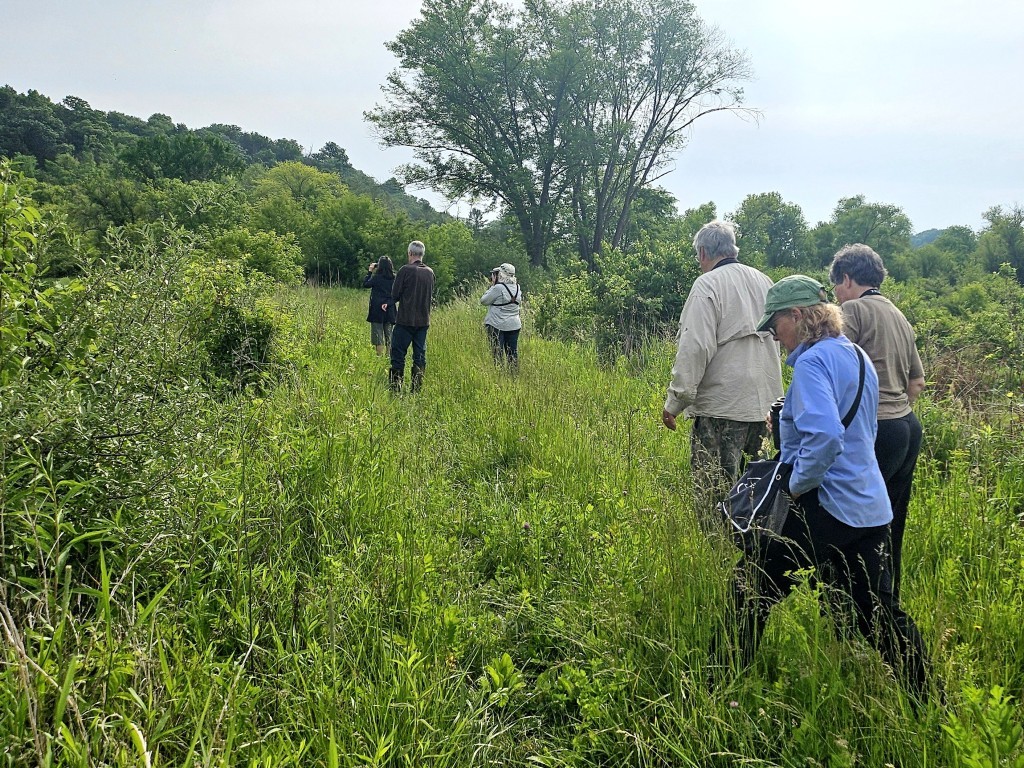
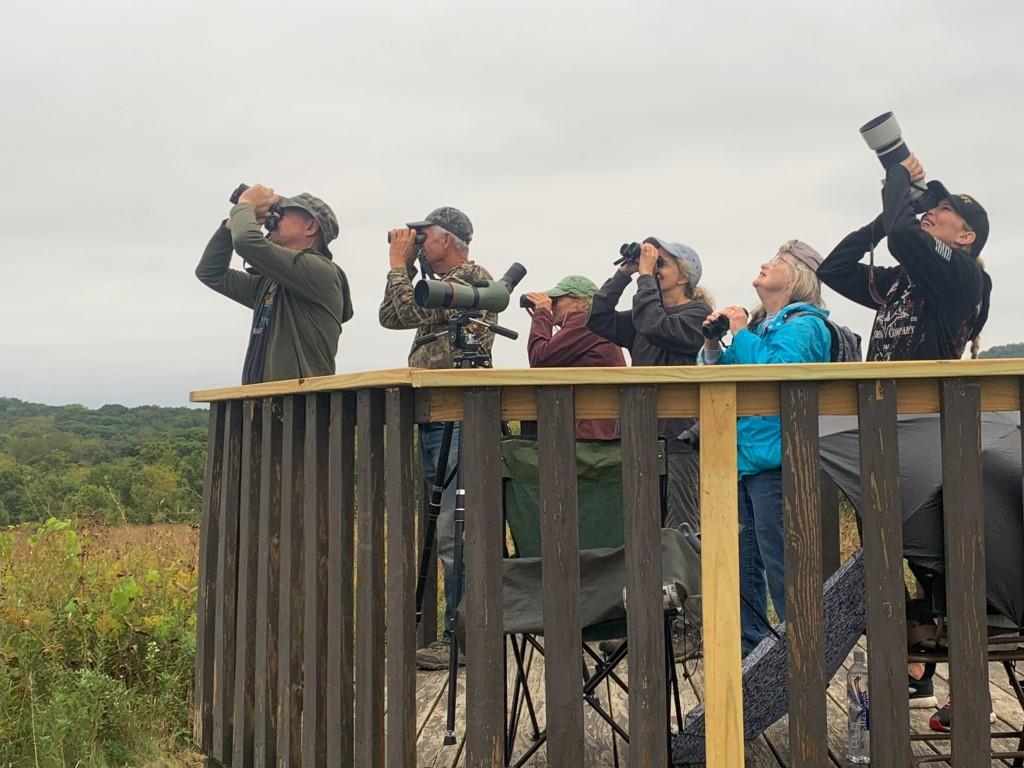
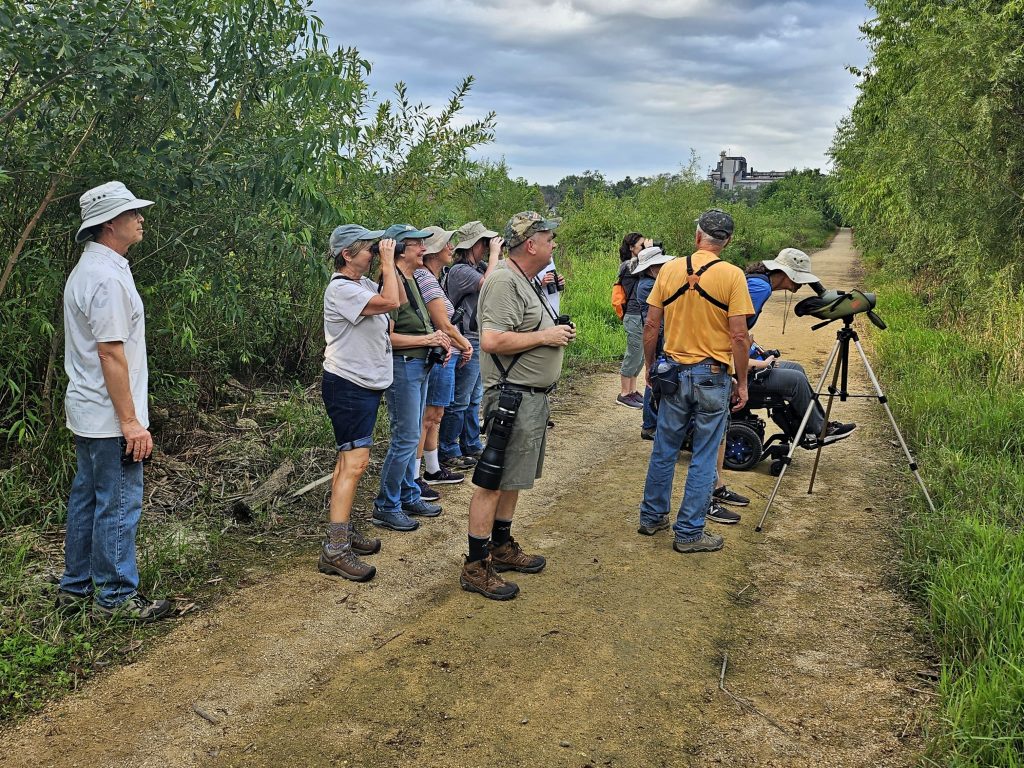
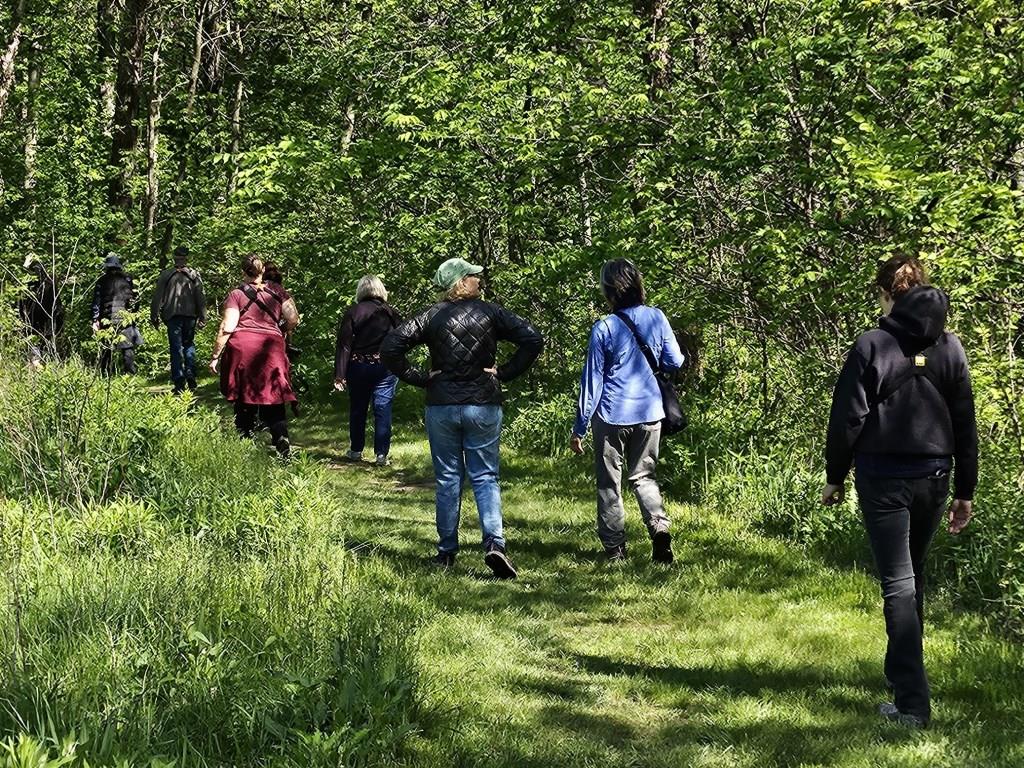
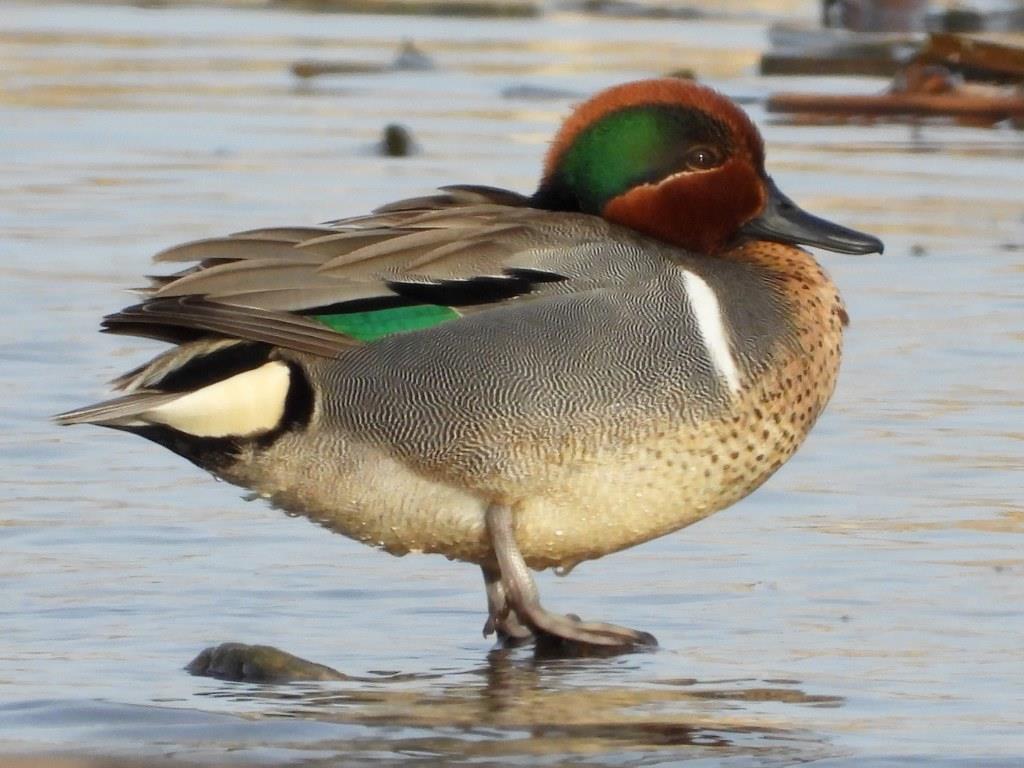
At sunrise a contingent of 26 Duck Waddle participants joined us. With spotting scopes and binoculars, we found Ringneck Duck, Bufflehead, Northern Pintail, American Widgeon, Gadwall, Northern Shoveler, Blue-winged Teal, and Green-winged Teal, along with the Mallards, White-fronted Geese, and Lesser Scaup. Of course, there were the resident Canada Geese, and in their midst was one Mallard-sized Cackling Goose.
Next the group went out Fish Lake Road where we saw large flocks of White-fronted Geese and Mallards, and 6 Sandhill Cranes in a picked corn field. About ½ mile out the road, a flock of over 100 Trumpeter Swans were in a field to the west, flanked by more White-fronted Geese, several Snow Geese, over 200 Northern Pintails, and a Ross’s Goose. Unfortunately, when we reached the parking lot at the end of Fish Lake Road, the wind kicked up and it began to rain, but we did see 4 Northern Harriers and several Bald Eagles.
From Fish Lake Road we drove to the Blakes Lake parking lot on the east side of Green Island. Trees shielded us from the wind, and we ventured about 100 yards out the dike where there were large flocks of waterfowl in the open water. A raft of diving ducks had Lesser Scaup, Ring-necked Duck, Bufflehead, Common Goldeneye, Canvasback, Hooded Merganser, and Common Merganser. In the distance were more Trumpeter Swans, American White Pelicans, and Double-crested Cormorants.
At around 9 a.m., it was time to head to Sabula for breakfast and to check out Sabula’s three lakes. The biggest surprise of the day was when I decided to stop at the North Lake boat ramp. The water was ¾ frozen and was covered by hundreds of gulls and Bald Eagles. We counted 183 eagles sitting in trees, and those on the ice were comical to watch as they attempted to pull frozen shad out of the ice. Another 17 eagles were on the north edge, making the count over 200 eagles—many within 100 yards of our cars! The gulls were Ring-billed Gulls, Herring Gulls, and at least one Iceland Gull.
Following a well-deserved breakfast and hot coffee, we checked out South Sabula Lake, but it had white caps and few waterfowl. On the way back to the main road there were around 100 Common Mergansers, 30 Red-breasted Mergansers, and a dozen Ruddy Ducks on Middle Sabula Lake.
Overall, it was a great “Duck Day!”
Derogatory expressions such as bird-brain, crazy as a loon, and dumb as a dodo imply birds lack intelligence or common sense. But modern research has debunked that idea, finding bird brains are quite complex and neuron dense, displaying similar neuronal organization and connectivity to mammals. In fact, birds have larger brains relative to their body size than all other vertebrates except mammals.
Learning how to learn is a measure of intelligence. Some birds, notably corvids such as Crows, Ravens, and Blue Jays, have demonstrated the ability to solve problems and use tools. For example, scientists have observed Crows in the wild using sticks with their beaks to extract insects from logs, and in labs, Crows have solved puzzles to get to food. They have also observed Carrion Crows and American Crows cracking hard-shelled nuts by dropping them on crosswalks, letting cars run over them.
Birds must learn the complex activity of song. Songs of the same species vary from region to region depending on what young birds learned from their parents. Young males in a new territory will often sing the “dialect” applicable to that territory.
The hippocampus region controls bird memory. In birds that engage in caching (hiding seeds or nuts in locations and later retrieving them), the hippocampus is larger than birds who do not cache. The hippocampus in the Black-capped Chickadee, for example, grows during cache season, heightening its ability to remember its cache locations.
And how do birds compare to our beloved domesticated pets? Crows and Parrots often perform as well as dogs in tests that involve reasoning or learning. Blue Jays are able to master food-locating tasks that cats cannot. House Sparrows have learned to open automatic doors to grocery stores and cafes by hovering in front of the electric eye sensors. Can Fido or Fluffy do that? Maybe. But then, can Fido or Fluffy find their way to South America and back? Maybe not.