Pileated Drummings
March 2026 – Spring Issue
CONTENTS
President’s Corner
BY MARTY CORFMAN
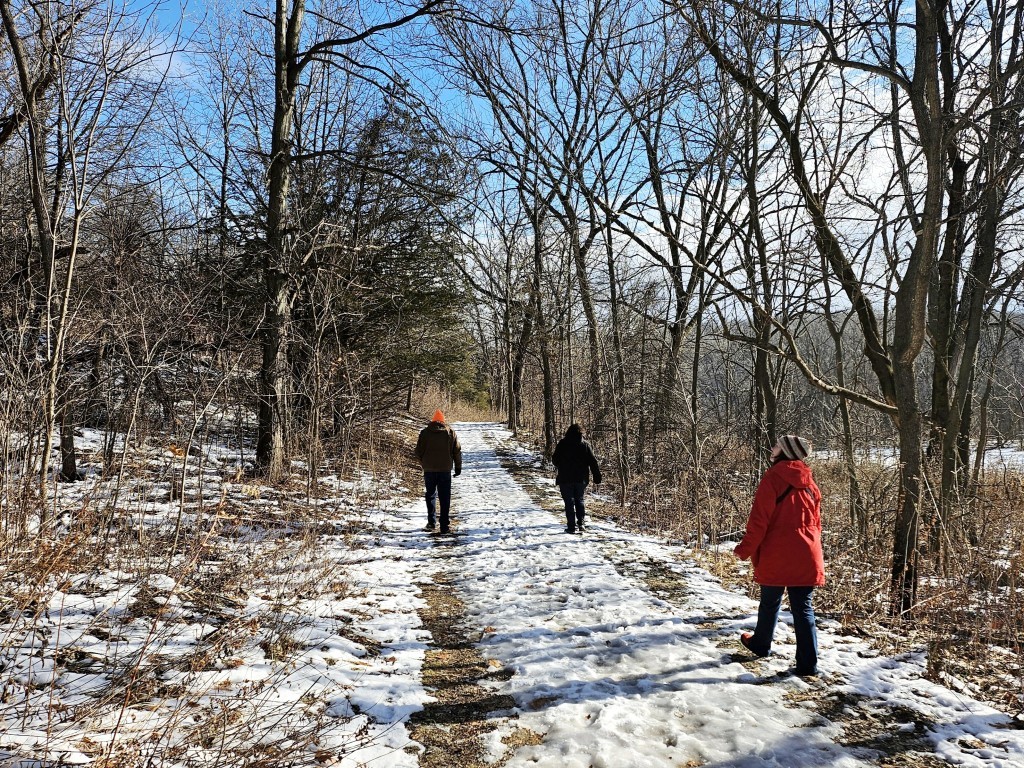
As I’m writing this column on February 16, 2026, Dubuque is in the midst of a week-long stretch of extremely unseasonably warm weather. Sunny days with temps over 50 in February find me in short sleeves and with the wanderlust to go AWOL into the woods and fields in search of birds! The sightings are often frustratingly scarce, but we midwestern birders get excited with all sightings. Tony Moline, on our board, recently put a couple of sock feeders and scattered bird food at the Riprow Valley entrance at Mines of Spain (view map). If you’re starved for bird sightings, you can see many of the usual suspects there. Feel free to add some food or suet! It’s a nice spot.
Speaking of Mines of Spain, the last few times I’ve been there, I have seen and/or heard at least one Pileated Woodpecker in the woods near the Canoe Launch and by Horseshoe Bluff. They are so much easier to see this time of year and seem to be very active right now.
You’ll have a chance to bird with us very soon if you join the 47th annual Duck Waddle on Saturday, March 7th! We start very early from Dubuque, but it’s worth it! We hope many of you choose to join us this year. Check out all the details on our EVENTS page.
© Marty Corfman
Snapshot Dubuque Iowa
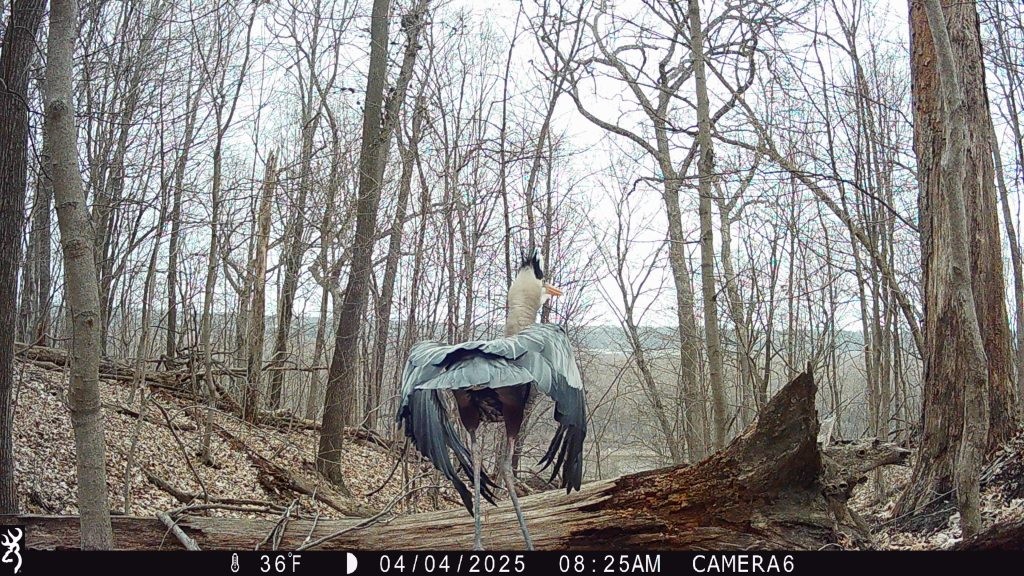
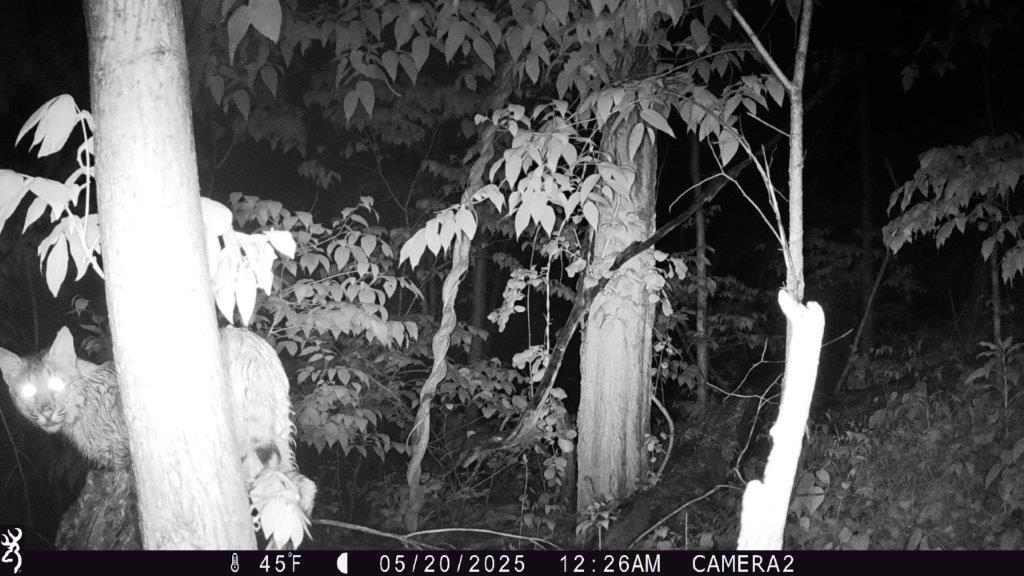
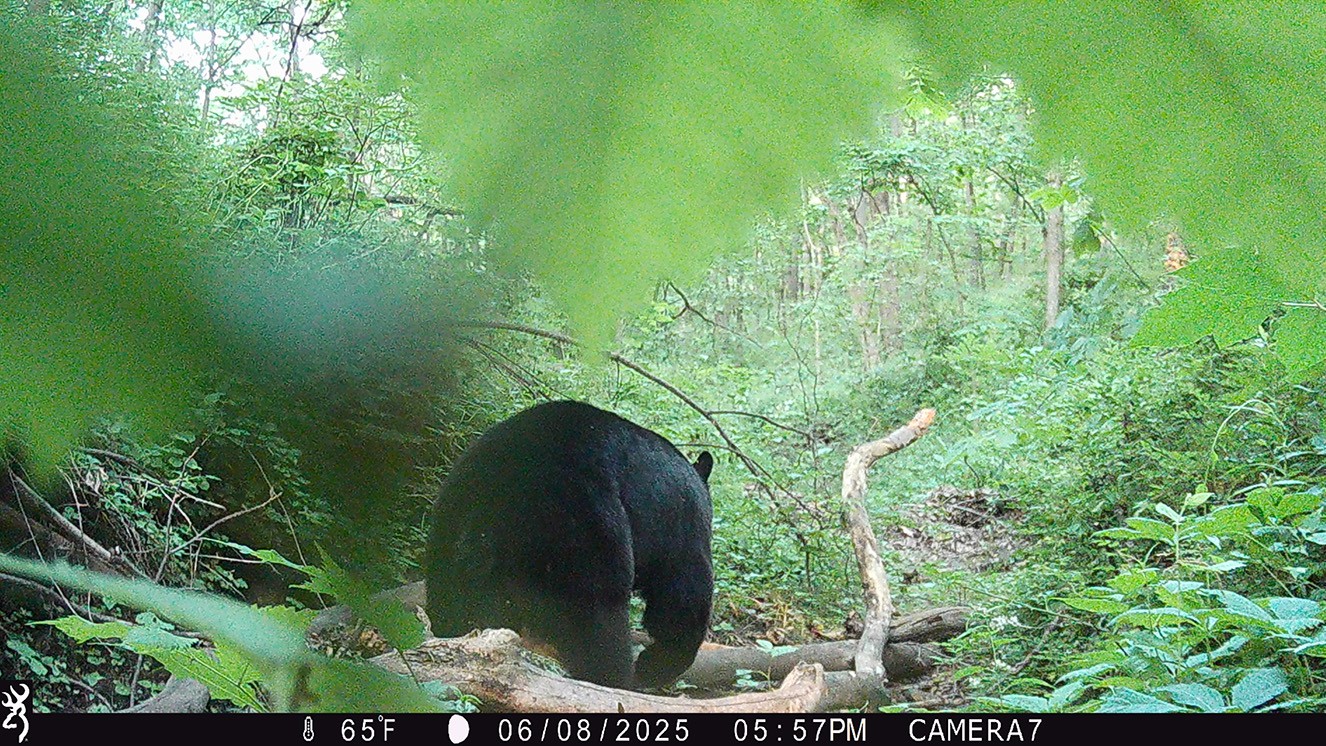
Herons, Bobcats, and Bears! – Introducing Snapshot Dubuque Iowa, a Citizen Science Project to Classify Trail Camera Images
BY JASON DENLINGER, Naturalist for Dubuque County Conservation
Snapshot Dubuque Iowa is an online citizen-science project that asks volunteers to identify wildlife photos collected from a network of 25 cameras located in five different conservation areas within the county of Dubuque including: Mines of Spain, Swiss Valley, Whitewater Canyon, John Deere Marsh, and Bankston.
With your help, the Dubuque County Conservation Department hopes to have a better understanding of the species within these areas and how they are influenced by factors such as human development, seasonal change, and predator/prey relationships. This knowledge can help management staff to improve and protect habitat for wildlife.
The trail cameras are motion activated, and each one is set to snap three shots upon being triggered. A small team (including Audubon members, Lori & Tim Ollendick and Tom Davis) maintains the cameras and retrieves and organizes thousands of images captured by each camera before uploading them to the Snapshot Dubuque Iowa project. This large number of images necessitates a wider group of volunteers to help classify any wildlife in the photos. Less common animals, like Sandhill Cranes and bears, will be a joyful surprise while classifying; and more common ones, like deer and squirrels, can captivate volunteers with some of their behaviors. While the majority of animals captured by the cameras are mammals, at least 6% of the images observed are of various bird species including songbirds, owls, turkeys, eagles, waterfowl, and herons.
Currently the project has 6,286 subjects (image sets) which have led to over 270,000 classifications by about 2,400 volunteers from locations worldwide. However, additional volunteers are always needed, and we particularly hope to engage citizens of Dubuque and the state of Iowa in this project!
To try out the project as an individual or family, visit Snapshot Dubuque Iowa, or just do a quick internet search for Snapshot Dubuque Iowa. We strongly encourage participants to create a profile to get the most from the site and assist with our data analysis. Then check out the TUTORIAL (under the CLASSIFY tab) and FAQs (under the ABOUT tab). Please make sure you are signed in before starting to classify. You may also want to refer to the FIELD GUIDE available via a button to the right of the current photo. Have fun observing local wildlife!
Observing Owls in Winter
BY KEN KISS
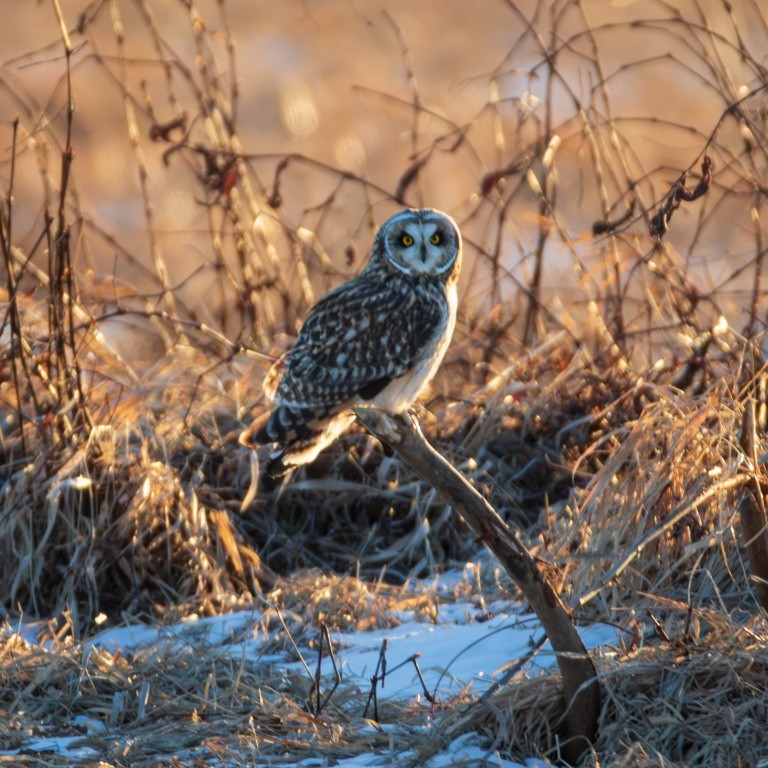
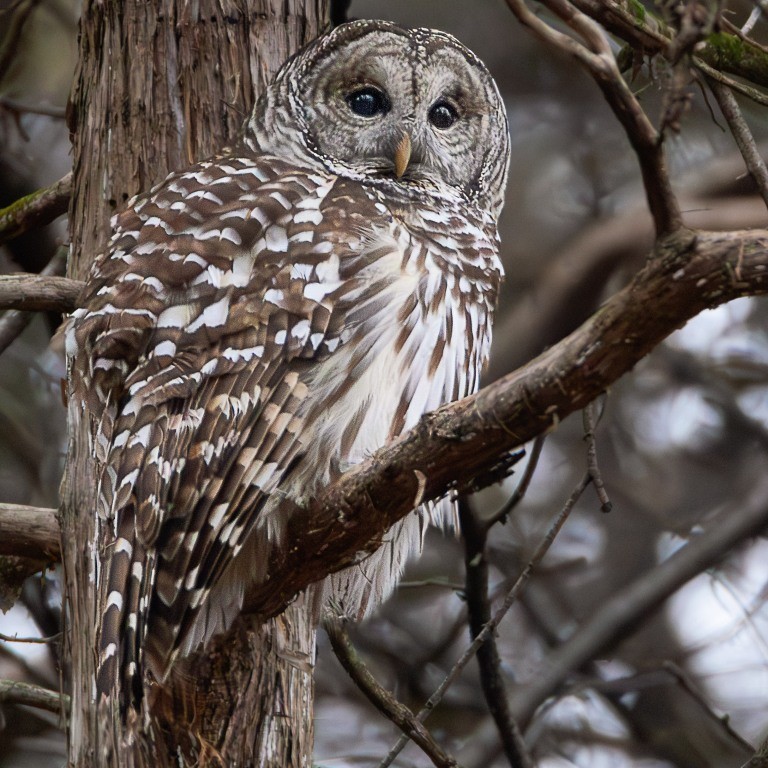
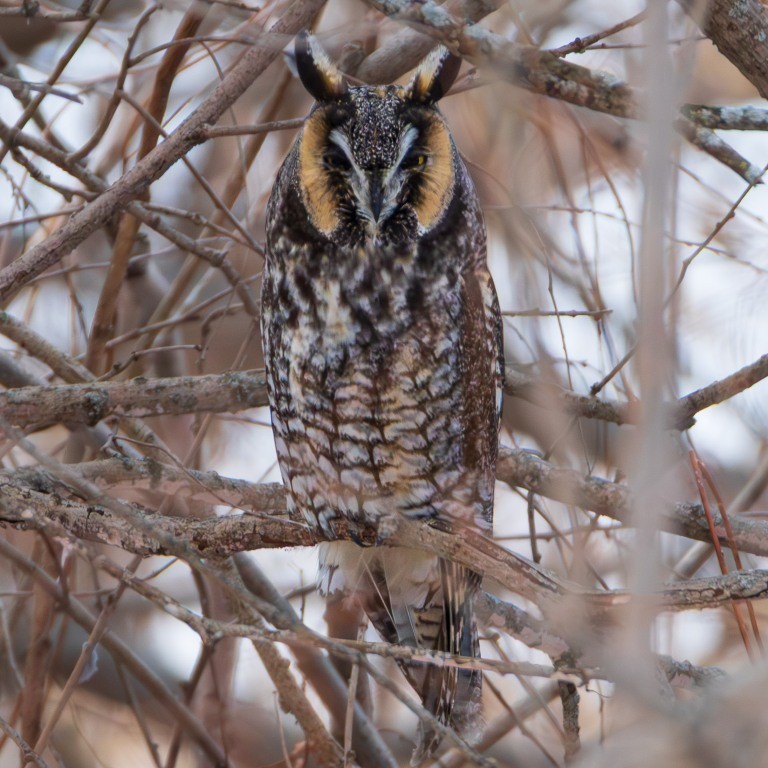
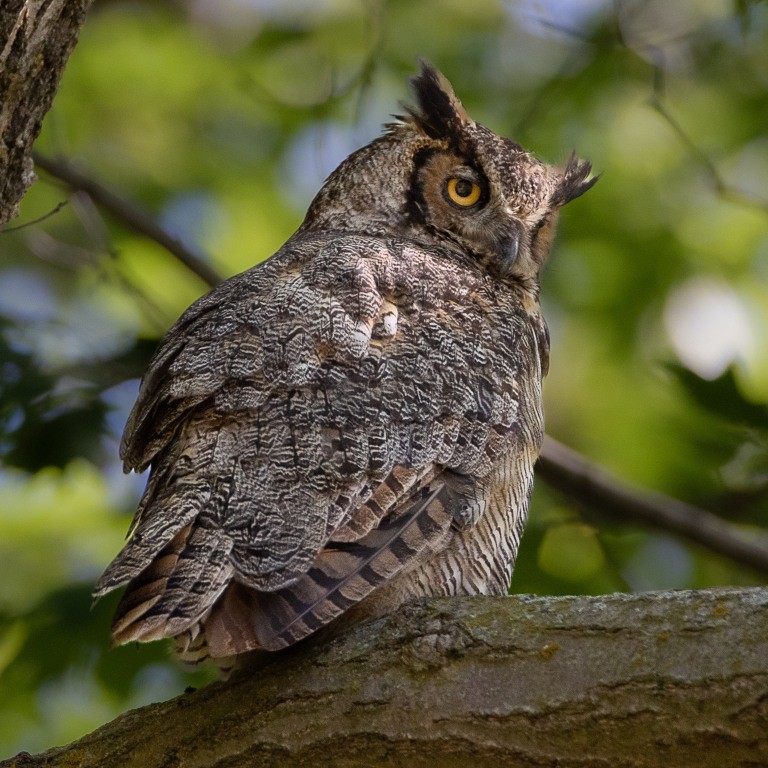
Winter can be a great time to observe owls because of greater visibility in the woodlands. Also, several owls are more prevalently found in Iowa in the winter because they may migrate from Canada and the northern states. These are Long-eared Owls, Short-eared Owls, and Northern Saw-whet Owls. On rare occasions, Snowy Owls may show up in Iowa.
Evening and night are good times to hear owls calling. Just last week after leaving an event at EB Lyon at around 8:15 PM, it was cool to hear a chorus of at least 3 Barred Owls. They were even doing their caterwauling call, and the chorus kept up for about 20 minutes.
It’s fun to observe owls, but maintain your distance so you don’t disturb them. The important thing is to use common sense, so you don’t try to get too close to them and stress them. Food is scarce in winter, and you do not want to stress owls, causing them to waste energy by flying unnecessarily. Great-horned owls start nesting in this area anywhere from mid-January to early February. So, during the winter months while the female is nesting, the male Great-horned Owl must hunt for two. Barred Owls start nesting about a month later.
eBird Sensitive Species
Some owls are considered “sensitive” in some locations, in which case locations of sightings are hidden in eBird. For example, Long-eared Owls are considered a sensitive species in our area, so if you report seeing any on an eBird checklist, anyone looking at your checklist will not see that species listed.
Learn more from eBird’s Help Center section on Sensitive Species in eBird. If you know the location of a sensitive species, you are asked not to share it, in order to protect the species.
© Ken Kiss
Snowy Owl Sighting
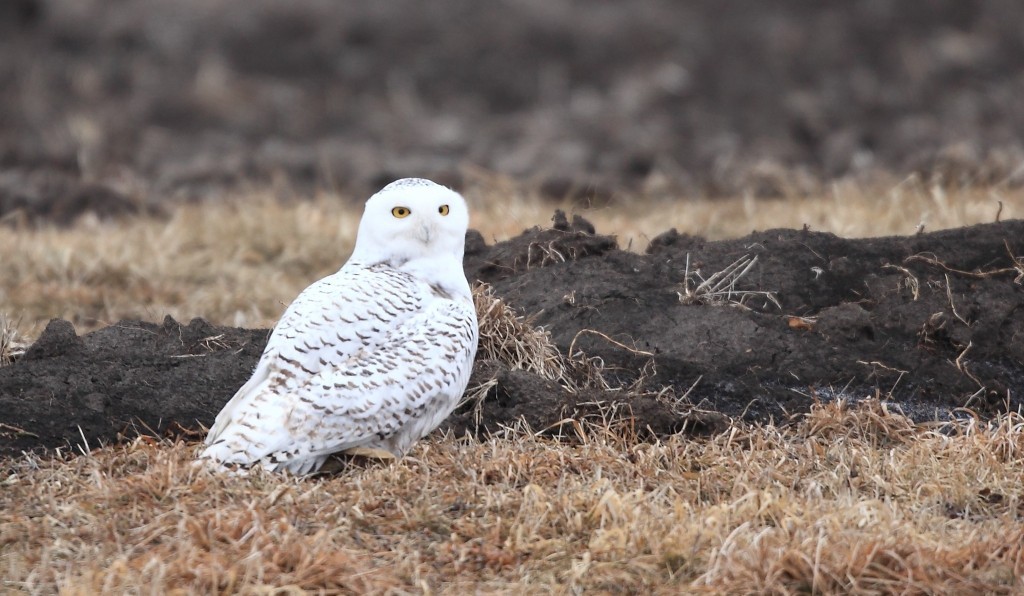
In early February, a Snowy Owl was observed over a 5-day period near DeWitt, Iowa!
Snowy Owl sightings and locations can be found in eBird, since this species is not flagged as sensitive, although it is rare.
© Tony Moline
More on Protecting Owls
To learn more about guidelines for watching owls, read Bird Canada’s Owl Observation Tips for Birders and Photographers.
Bird-Brained: Insult or Compliment?
BY KARI ZELINKAS
Derogatory expressions such as bird-brain, crazy as a loon, and dumb as a dodo imply birds lack intelligence or common sense. But modern research has debunked that idea, finding bird brains are quite complex and neuron dense, displaying similar neuronal organization and connectivity to mammals. In fact, birds have larger brains relative to their body size than all other vertebrates except mammals.
Learning how to learn is a measure of intelligence. Some birds, notably corvids such as Crows, Ravens, and Blue Jays, have demonstrated the ability to solve problems and use tools. For example, scientists have observed Crows in the wild using sticks with their beaks to extract insects from logs, and in labs, Crows have solved puzzles to get to food. They have also observed Carrion Crows and American Crows cracking hard-shelled nuts by dropping them on crosswalks, letting cars run over them.
Birds must learn the complex activity of song. Songs of the same species vary from region to region depending on what young birds learned from their parents. Young males in a new territory will often sing the “dialect” applicable to that territory.
The hippocampus region controls bird memory. In birds that engage in caching (hiding seeds or nuts in locations and later retrieving them), the hippocampus is larger than birds who do not cache. The hippocampus in the Black-capped Chickadee, for example, grows during cache season, heightening its ability to remember its cache locations.
And how do birds compare to our beloved domesticated pets? Crows and Parrots often perform as well as dogs in tests that involve reasoning or learning. Blue Jays are able to master food-locating tasks that cats cannot. House Sparrows have learned to open automatic doors to grocery stores and cafes by hovering in front of the electric eye sensors. Can Fido or Fluffy do that? Maybe. But then, can Fido or Fluffy find their way to South America and back? Maybe not.
American Crow & Black-capped Chickadee © Mary Leigh
© Joyce Hartig
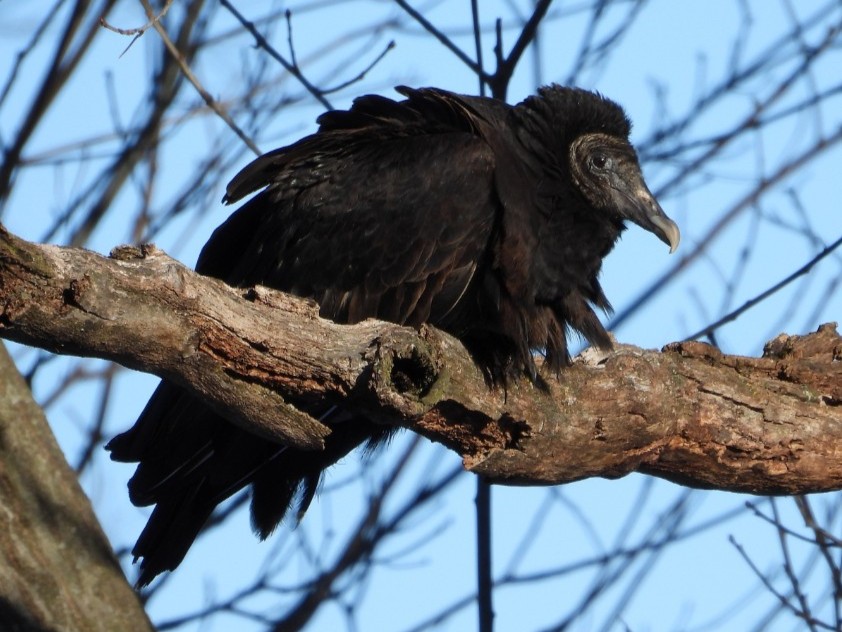
Black Vulture Rescue
BY TONY MOLINE
On January 27 while doomscrolling through Facebook, I came across something that shocked me. The Four Mounds Foundation had only 10 minutes earlier posted two photos of a Black Vulture. Understanding the significance, I contacted other birders and immediately set off to find the bird.
David Shealer was the first to arrive and noted that the bird did not seem to be in good health (not surprising, considering the frigid temperatures). Black vultures are not native to Iowa. In fact, this would be the first county record for Dubuque. Their typical range does not extend north of Missouri. Even more unusual was that this bird was found in the dead of winter, when even our native Turkey Vultures have long gone south.
An attempt was made to capture the bird. However, it still had the strength and energy to fly, and it flew into a nearby tree. A plan was hatched to open a heated shed door in hopes that the bird would seek shelter there. Miraculously, the bird did, and the door was shut. Birders brought food offerings to sustain the bird overnight, and Dubuque County Conservation was contacted. The following day, the bird was picked up and transported to the RARE group in Iowa City (Raptor Advocacy Rehabilitation & Education), where it will be nursed back to health and eventually released back into the wild.
Follow-up by Mary Leigh
Since about one month had gone by, I decided to check on the status of the Black Vulture, hoping to add some good news. Unfortunately, I received a reply on February 27 with the sad news that our rescued bird had passed away earlier in the week. The RARE group was devastated, as they had been hopeful that the bird would recover. They were treating it for Aspergillosis, which is a serious fungal disease. They shared that they did all they could and that the Vulture had a safe, warm passing. We appreciate their efforts.
Dubuque’s 2025 eBird Claim to Fame
BY MARY LEIGH
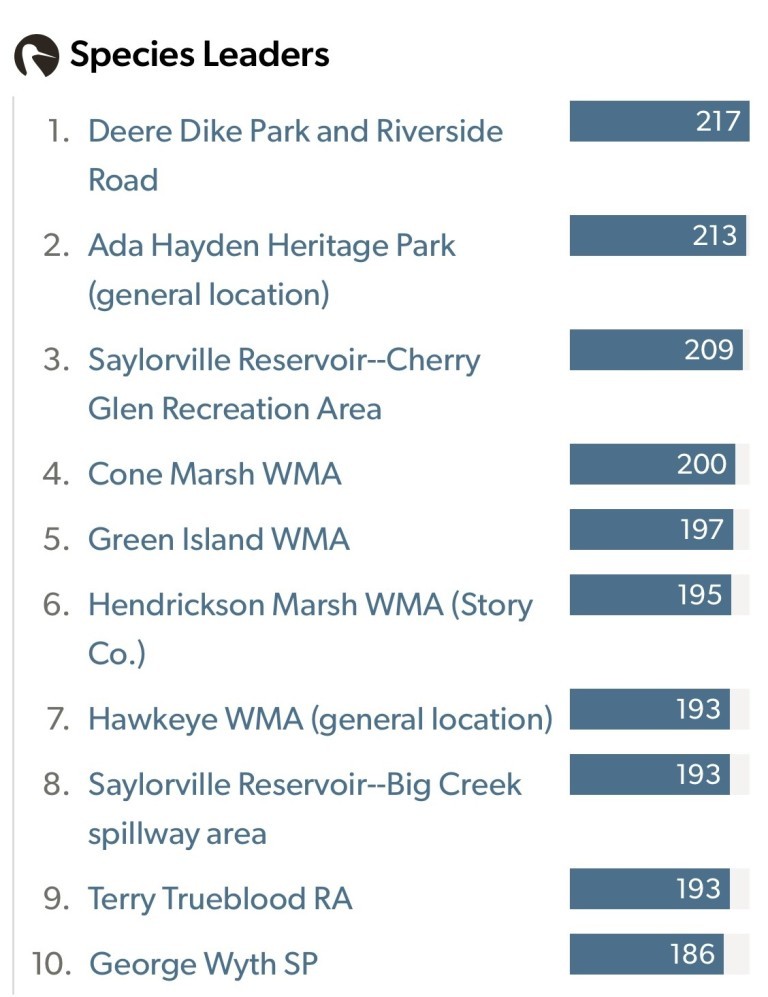
I was recently made aware of some local eBird hotspot news: Deere Dike Park in Dubuque was ranked the #1 hotspot for species count in the state of Iowa for 2025! There were a whopping 217 bird species reported in eBird for that location. The runner up was Ada Hayden Heritage Park in Ames, with 213 species. (This claim to fame is based on a screenshot taken on New Year’s Eve, prior to eBird restarting the statistics!)
Deere Dike Park is also known as John Deere Marsh. The eBird hotspot for this location includes Riverside Road, which has a stretch that is often good for viewing waterfowl and shorebirds. Unfortunately for birders, there is a railroad track in between the road and the Mississippi River, so viewing is from a distance. A scope is not always necessary, depending on how far away the birds are, but it is often helpful.
There were 4 species reported for the first time at the location:
- Red Crossbill (11/18/25)
- Sabine’s Gull (9/21/25)
- Red Knot (5/28/25)
- Cinnamon Teal (4/7/25)
The Deere Dike Park eBird hotspot is off to a good start this year with 79 species, which is enough to rank it as the #1 hotspot in the state of Iowa for 2026, at least for now.
Let the birdwatching fun continue!
Bread & Popcorn = Junk Food for Birds
BY MARY LEIGH
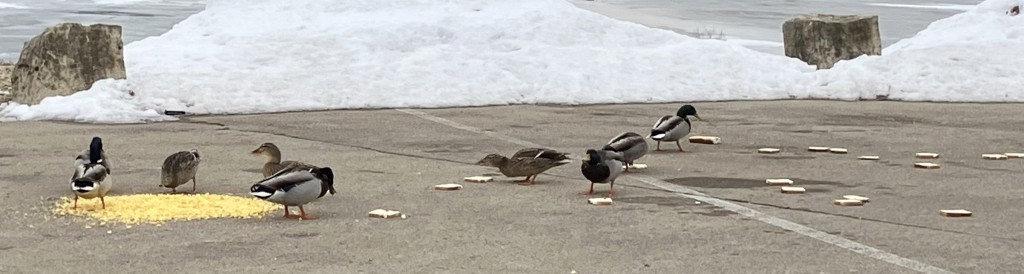
One of our readers shared the photo below of Mallards eating popcorn and slices of bread at A.Y. McDonald Park in Dubuque. We’re sure that anyone feeding these foods to the birds has the best of intentions, but doing so is not good for the birds.
A.Y. McDonald Park
Dubuque, IA
Our summer and fall newsletters last year included articles on this topic, but most on our email list now were not on our list then. (By the time of our winter newsletter, our email list almost tripled because the National Audubon Society shared many email addresses for supporters in our chapter’s coverage area.)
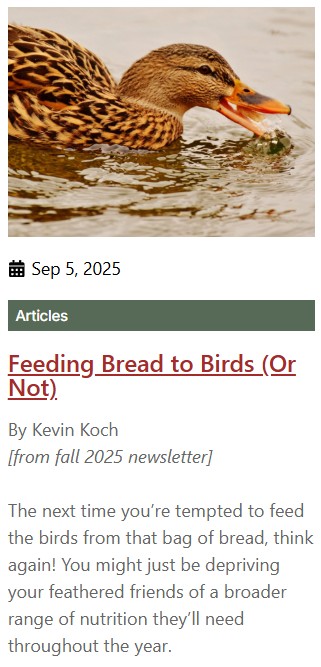
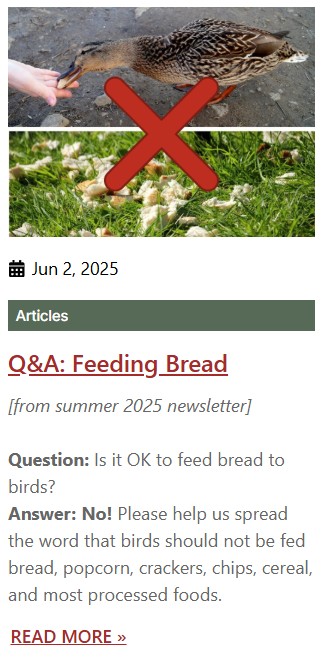
So, although we’re probably preaching to the choir, we’d like to repeat the message and share image links to those earlier articles:
2025 Christmas Bird Count
BY MARY LEIGH
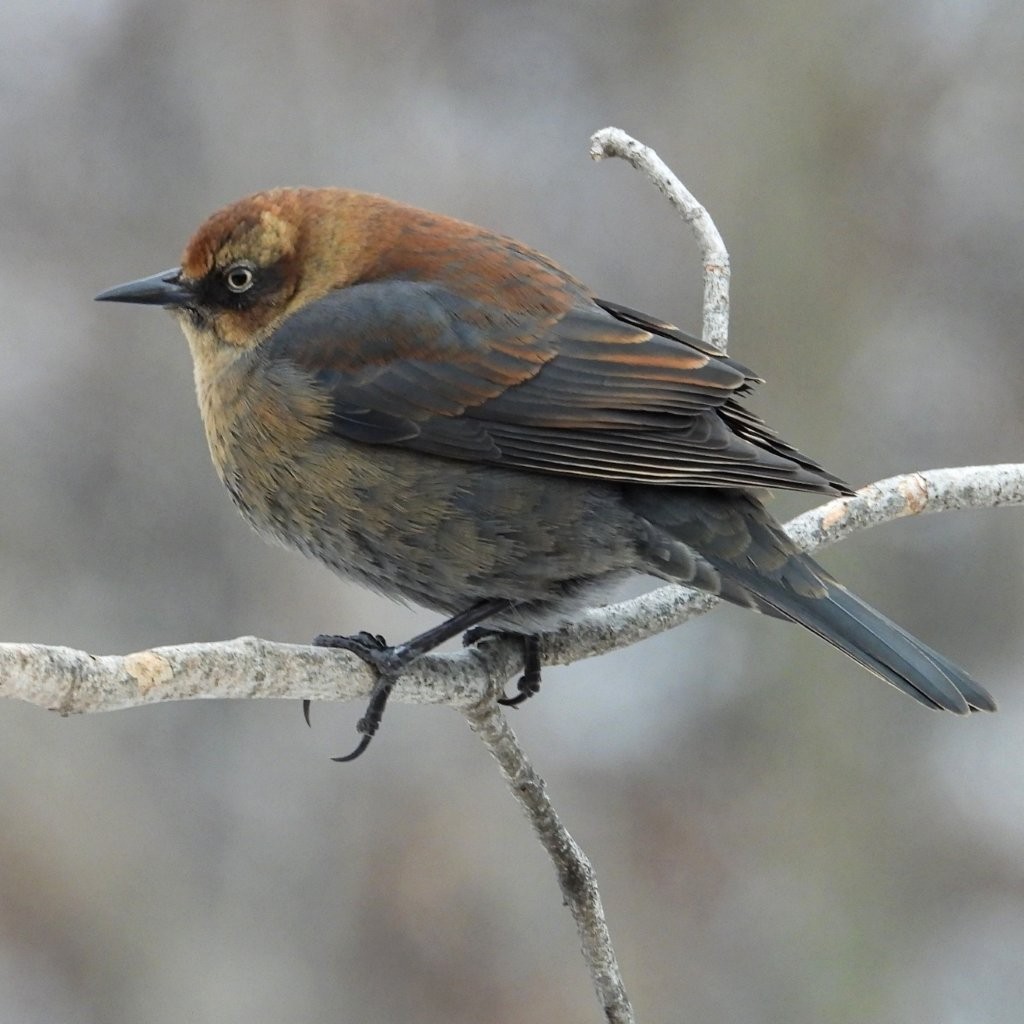
On Saturday, 12/20/25, our chapter participated in the National Audubon Society’s 126th annual Christmas Bird Count (CBC), where we counted birds in our 15-mile diameter circle. Tony Moline was our organizer, and his final report showed that 25 people were split into 9 groups. We also had a couple people doing feeder watching from home. (One was my husband, who agreed to keep a lookout for the Rusty Blackbird we had seen 2 days earlier, since I would be away counting birds at Mines of Spain. He did not see it.)
On count day, birds are counted individually. As a follow-up, we report any species seen during “count week,” which includes the 3 days before and 3 days after count day. On the count week days, we track only the additional species seen, with no individual counting. (So the Rusty Blackbird from 2 days earlier was listed for count week.)
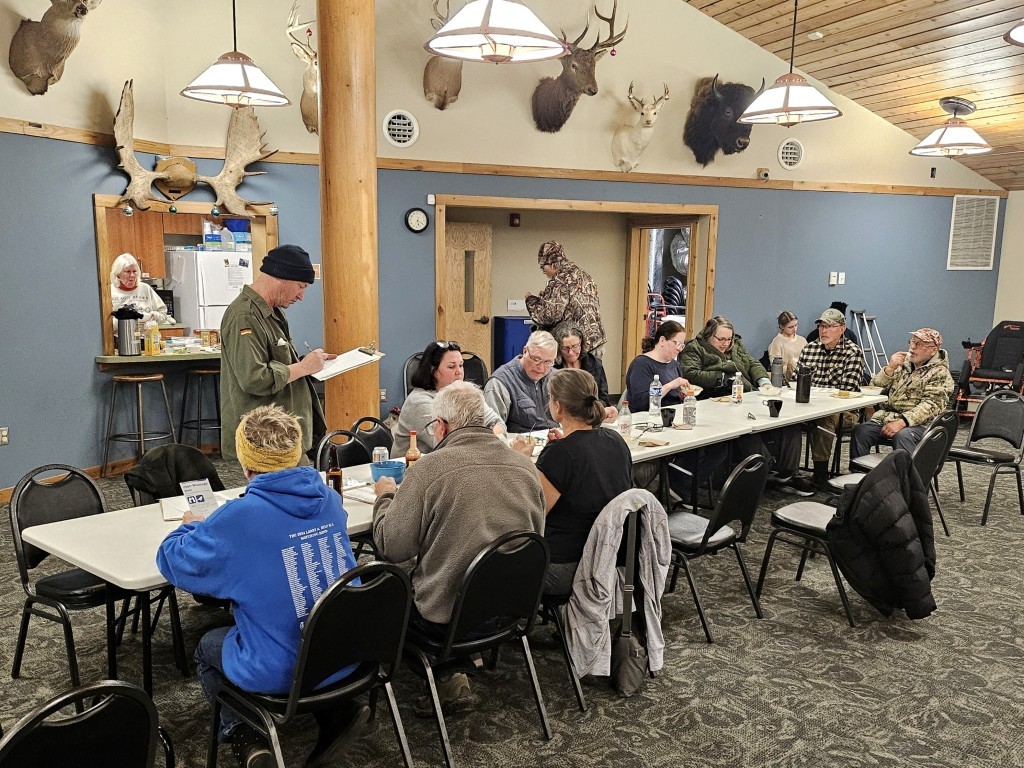
We had a nice turnout for our compilation and potluck at EB Lyons. We enjoyed a chili supper and then went through all the species, with groups sharing their counts, in order to add up the number for each species.
In total, we saw 71 species on count day and counted 5758 birds, and we added 7 more species for count week.
See species details 🐦
12/20/25 Christmas Bird Count Results
CW = Count Week Addition (found 3 days before or after count day)
- Canada Goose (1874)
- Trumpeter Swan (38)
- Tundra Swan (2)
- Gadwall (15)
- American Black Duck (2)
- Mallard (546)
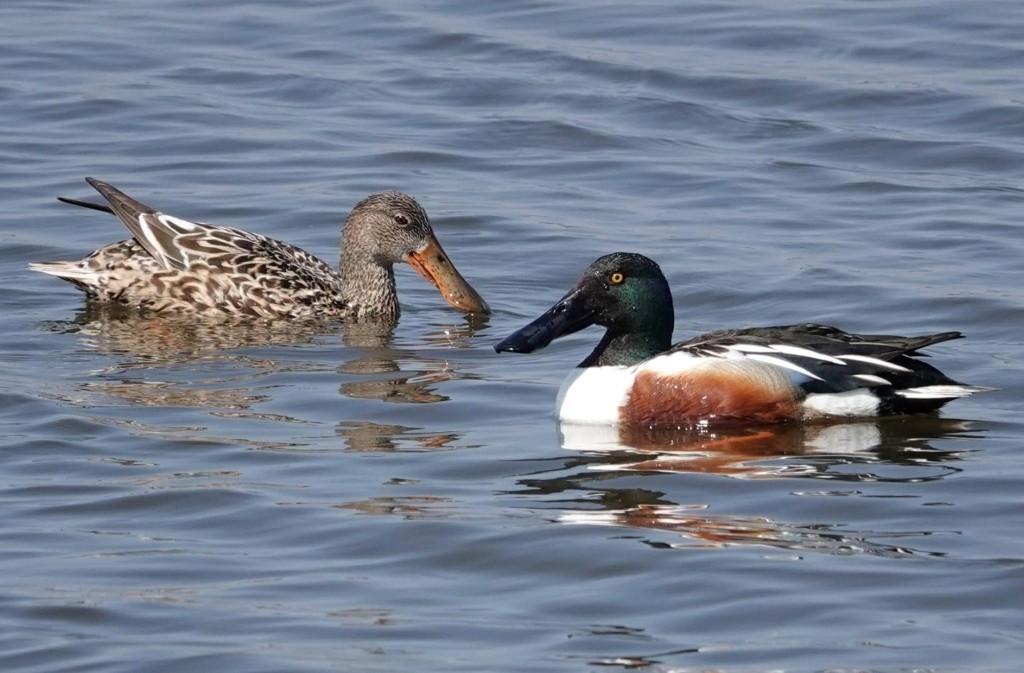
- Northern Shoveler (1)
- Green-winged Teal (2)
- Canvasback (2)
- Ring-necked Duck (3)
- Lesser Scaup (16)
- Bufflehead (2)
- Common Goldeneye (61)
- Hooded Merganser (CW)
- Common Merganser (2)
- Ruddy Duck (6)
- Wild Turkey (26)
- Great Blue Heron (CW)
- Golden Eagle (1)
- Sharp-Shinned Hawk (1)
- Cooper’s Hawk (4)
- Bald Eagle (63)
- Red-shouldered Hawk (1)
- Red-tailed Hawk (29)
- Rough-legged Hawk (5)
- American Coot (2)
- Ring-billed Gull (1)
- Rock Pigeon (162)
- Eurasian Collared-Dove (25)
- Mourning Dove (83)
- Eastern Screech-Owl (2)
- Great Horned Owl (2)
- Barred Owl (4)
- Belted Kingfisher (2)
- Red-headed Woodpecker (1)
- Red-bellied Woodpecker (72)
- Yellow-bellied Sapsucker (8)
- Downy Woodpecker (93)
- Hairy Woodpecker (14)
- Northern Flicker (17)
- Pileated Woodpecker (6)
- American Kestrel (32)
- Northern Shrike (CW)
- Blue Jay (81)
- American Crow (130)
- Horned Lark (CW)
- Black-capped Chickadee (104)
- Tufted Titmouse (17)
- Red-breasted Nuthatch (CW)
- White-breasted Nuthatch (69)
- Winter Wren (7)
- Carolina Wren (3)
- Golden-crowned Kinglet (3)
- Ruby-crowned Kinglet (2)
- Eastern Bluebird (23)
- American Robin (140)
- European Starling (487)
- Cedar Waxwing (48)
- Yellow-rumped Warbler (4)
- American Tree Sparrow (41)
- Fox Sparrow (4)
- Dark-eyed Junco (439)
- White-crowned Sparrow (15)
- White-throated Sparrow (125)
- Song Sparrow (9)
- Swamp Sparrow (1)
- Eastern Towhee (2)
- Northern Cardinal (87)
- Red-winged Blackbird (1)
- Rusty Blackbird (CW)
- Common Grackle (3)
- Brown-headed Cowbird (1)
- House Finch (129)
- Purple Finch (14)
- Pine Siskin (CW)
- American Goldfinch (67)
- House Sparrow (468)
- Eurasian Tree Sparrow (6)
Total Species Reported: 71
Total Individuals: 5758
Count Week Additions: 7
Grand Total Species Count: 78
To compare these 2025 results with 2022 – 2024, see the Christmas Bird Count section on our BIRDS page.
Birds seen in 2025 that had not been seen in those prior 3 years were Green-winged Teal (2), Ruddy Duck (6), Great Blue Heron (CW), Golden Eagle (1), Eurasian Collared-Dove (25), Northern Shrike (CW), Ruby-crowned Kinglet (2), Eastern Towee (2), and Rusty Blackbird (CW).
2026 CBC - Count Week
© Mary Leigh
An International Bird Story
Since we included an article about a local bird in need of help as well one about birds being smart, we’ll end with the story of a bird in Germany in need of help and smart enough to ask for it!
Here’s the link: Injured seabird desperately pecks at hospital door for help
CALENDAR OF EVENTS
Upcoming Events:
- SAT 3/7/26: Annual Duck Waddle
- THU 3/12/26: March Program: Voyage to the Bottom of the World with Ty Smedes
- THU 4/9/26: April Program: Warbler Identification Made Easy with Bob Walton
- SAT 5/9/26 (tentative date): Annual Spring Species Count
- THU 5/14/26: May Program: Driftless Area Research on Red-shouldered Hawks and Cerulean Warblers (& More) with Jon Stravers
CHAPTER LEADERSHIP
OFFICERS
President: Marty Corfman
Vice President: Ken Kiss
Treasurer: Andrea Pellerito
Secretary: Kari Zelinskas
BOARD MEMBERS
- Mary Leigh (Web Admin)
- Tony Moline
- Maggie O’Connell
- Lori Ollendick
- Joe Tollari
- Bob Walton (Iowa Audubon Liaison)
- Sandy Walton
COMMITTEE CHAIRS
Membership: Mary Leigh
Program: Bob & Sandy Walton
Field Trips & Volunteer Opportunities: Tony Moline
Conservation: [open position]
Publicity: Marty Corfman
Newsletter: Marty Corfman, Mary Leigh
Technology: Lori Ollendick
Thanks to Kari Zelinskas for volunteering to trade board positions with Maggie O’Connell to become our new secretary!